
Our verdict
The most complete SEO toolkit, if the price fits
Best for: Bloggers, marketers and businesses serious about growing Google traffic
Pros
- Huge keyword and backlink database
- Excellent site audit with clear fixes
- Strong competitor and traffic research
- Daily rank tracking
- Free plan and 7-day trial
Cons
- Expensive for beginners (from $139/mo)
- So many tools that it takes time to learn
- Extra users and some toolkits cost more
- Free plan is very limited
Score breakdown

On this page
If you want more visitors from Google, you need to know what people search for, how your pages rank and what your competitors are doing. Semrush puts all of that, and much more, in one place. It’s one of the two big names in SEO software, alongside Ahrefs.
This Semrush review explains the main tools, the current plans and prices, and whether it’s worth paying for if you run a small site or blog.
Semrush at a glance
| Semrush | |
|---|---|
| Founded | 2008 |
| Free option | Free plan (limited reports per day) and 7-day trial |
| Paid plans | From $139/mo ($117.33/mo billed annually) |
| Main tools | Keyword research, site audit, rank tracking, backlinks, competitor research, content tools, AI visibility |
| Best for | Bloggers, marketers, agencies, small businesses |
What is Semrush?
Semrush is an online platform for SEO, content and competitor research. It collects data on billions of keywords and websites, then turns it into reports you can act on: which keywords to target, which technical problems are holding your site back, and where your competitors get their traffic and links.
Main features
Keyword research
The Keyword Magic Tool finds thousands of related keywords from a single idea, with monthly search volume, keyword difficulty, search intent and cost-per-click. It’s the fastest way to find topics people actually search for, and to spot easier keywords a newer site can rank for. Our keyword research guide shows how to use it step by step.
Competitor research
Enter any competitor’s domain to see the keywords it ranks for, its top pages, estimated traffic and where its backlinks come from. The Keyword Gap and Backlink Gap tools show opportunities your competitors have that you don’t.
Site audit
Site Audit crawls your website and lists technical SEO issues such as broken links, slow pages, missing meta descriptions and duplicate content, sorted by priority with explanations of how to fix them. For many site owners this tool alone is worth the subscription.
Rank tracking
Position Tracking checks your rankings daily for the keywords you choose, on desktop and mobile, in any location.
Backlink analysis
See who links to your site and your competitors’, find lost links, and identify toxic links that could be a problem.
Content and AI visibility tools
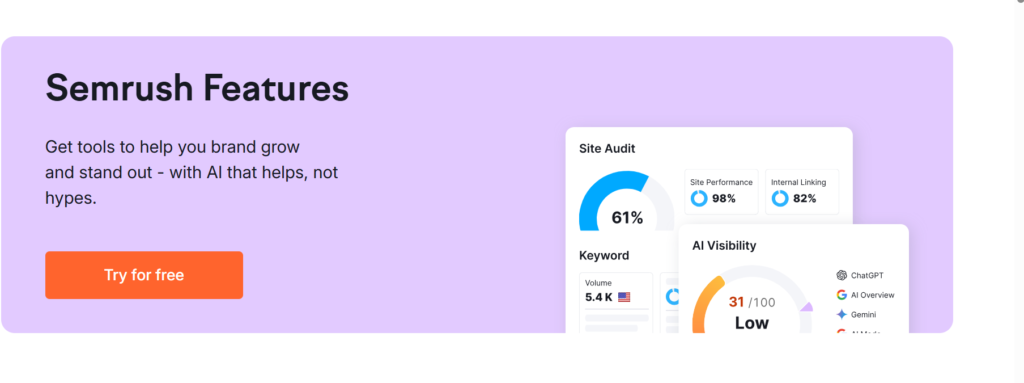
Content tools help you plan and optimise articles, and newer AI visibility reports show how your brand appears in AI search tools, which is becoming more important.
Semrush pricing
Semrush has recently reorganised its plans, so older reviews may show different plan names. Prices checked on October 13, 2026:
| Plan | Monthly | Billed annually | Sites to monitor | Tracked keywords |
|---|---|---|---|---|
| Free | $0 | — | 1 demo project | — |
| SEO | $139 | $117.33/mo | 5 | 500 daily |
| Starter | $199 | $165.17/mo | 5 | 500 daily |
| Pro+ | $299 | $248.17/mo | 15 | 1,500 daily |
| Advanced | $549 | $455.67/mo | 40 | 5,000 daily |
You can try paid features free for 7 days. The free plan is useful for quick checks, with a limited number of reports per day and no credit card needed.
Is Semrush easy to use?
Semrush has a lot of tools, and the first few sessions can feel overwhelming. The good news is that most people only need four of them: Keyword Magic Tool, Domain Overview, Site Audit and Position Tracking. Each has clear explanations, and the Semrush Academy offers free courses.
Who should use Semrush?
- Bloggers and content sites that rely on Google traffic.
- Small businesses that want to appear for local and service searches.
- Marketers and agencies that manage several sites or clients.
- Online stores that want to rank product and category pages.
If your site is brand new, start with free tools such as Google Search Console and the Semrush free plan. Upgrade once you’re publishing regularly and want to grow faster.
Semrush alternatives
- Ahrefs: excellent backlink data and a cheaper Starter tier. See Semrush vs Ahrefs.
- Google Search Console: free data on how your own site performs in Google, essential for every site.
Our verdict
Semrush is the most complete SEO toolkit we’ve looked at. Its keyword research, site audit and competitor tools can make a real difference to your traffic. The price is the main drawback for small sites, so use the free plan and trial to see whether you’ll use it enough to justify the subscription.
Frequently asked questions
How much does Semrush cost?
Semrush has a free plan. Paid plans include SEO at $139/month ($117.33 billed annually), Starter at $199, Pro+ at $299 and Advanced at $549 per month. Checked October 2026.
Is there a Semrush free trial?
Yes, Semrush offers a 7-day free trial, and a free plan with a limited number of daily reports and no credit card required.
Is Semrush worth it for beginners?
If you publish content regularly and want to grow organic traffic, yes. If you have a brand-new site with a handful of pages, start with the free plan and Google Search Console, and upgrade when you’re ready.
Semrush or Ahrefs?
Both are excellent. Semrush has more marketing tools and a free plan; Ahrefs is known for its backlink data and has a cheaper Starter tier. See our Semrush vs Ahrefs comparison.
The most complete SEO toolkit, if the price fits
Try Semrush free